
You are currently browsing the category archive for the ‘Health’ category.
 For me, talking about Euromedica is talking about a story of professional success in specialized recruitment.
I had the privilege to found Euromedica Spain in June 1992. The founder of the group John Fulford has to be recognized for the vision in putting together a group of British, a Belgian, a German and a French, Francis Rolland, who also deserves my personal gratitude for his support. John had had a previous experience in retained executive search with a generalist group and he could envisage the winning formula of building a very international team with experience in different segments of the Life Sciences field. As he used to say, we were “speaking the language of our clients”.
My experience was contributing from a background in OTC, branded Pharmaceuticals and API’s, but the partners based in the UK and Continental countries had also backgrounds in Medical Devices, Diagnostics and service companies. In the late 80’s and early 90’s specialized recruitment was a pioneer approach and clients immediately loved it. I still remember presentations and sales pitches to clients in many European cities and the result was extremely positive. Many of those clients are still trusting us their senior search needs 20 years later.
I learned the profession with Euromedica and I learned it very well. The process, methodology and working ethics were those of the AESC and that is a guarantee of even higher standards today. That is why renewing our association and strengthening our affiliation is very good news for Spanish and European biosciences clients at large. We have recently agreed that myself and the company I work for, EuroGalenus will work as the Spanish Associate office of the Euromedica group. Along these years we have lived together market changes and different ownership situations, but the current team continues to be an outstanding group of international professionals serving Life Sciences companies all over the world. …we even maintain the original Euromedica Madrid telephone number: +34 91 350 5556.
As a continuation of my post last June, a complement to understand the distribution and function segments of the Spanish employment in the health sector we are going to use different data. Data from the past 15 years of our executive search professional experience in EuroGalenus, in recruiting senior executives for our clients.
| Pharmaceutical companies |
41% |
| Hospital products and devices |
20% |
| OTC/EFP |
12% |
| Biotech/Diagnostics |
14% |
| Services |
13% |
The positions of General Manager and similar in Spain represent a 11% of the total and point two tendencies: an increase of territorial responsibility, including Portugal or other countries to become Iberia or South Europe. Another tendency is the reduction of competences of the Country Manager, losing areas like Manufacturing, R&D, Logistics or Clinical Research, with regional or HQ reporting or external outsourcing companies.
All the technical positions represent a third of the total and they are in clear ascent. Medical Affairs, Clinical Research, Market Access, Business Intelligence, Regulatory Affairs or Pharmacoeconomics are some frequent ones.
Another interesting information of this study is that, although the Pharmaceutical Industry is the biggest industrial employer, is not the only one. It has demanded a 41% of all the missions undertaken, complemented with another 12% of the segment without prescription: OTC/EFP, that includes Cosmetics, Nutrition, Toiletries and related.
Hospital Product companies and Medical Devices meant a 20% of the total in the period and those of Biotechnology/Diagnostics – in clear ascent a further 14%. Biotech and Diagnostics share some characteristics: high scientific contents, specialists target and Hospital or Lab environment. However, we must bear in mind that some Diagnostic products are not obtained through Biotechnology and also that many Biotechnology products are not designed for the Diagnostics market.
The current growth of the recruitment within the Health and Science Industries is taking place in the Services companies. Those that develop activities that the manufacturing companies used to perform previously in-house, like Marketing/Advertising, Market Research/Business Intelligence, PR/Communications, Editorial/CRM, Events, Human Resources and even Sales.
 A few days ago I attended the official presentation of Asebio‘s Annual report. Asebio is the Spanish Association of Biotechnology Industries and next year will be celebrating its 10th anniversary.
A long road has been completed from the early 90’s that I remember in the executive search profession. Then, the searches assigned to EuroGalenus were coming from foreign corporations just starting commercial operations in Spain. Usually Regional or Country Managers and their key board executives: CEO, CSO, Regulatory Affairs Director and/or Technical/responsible person. These executives were sourced from Pharmaceutical companies as the problems they were facing were very similar: approval, reimbursement, marketing, etc. Most of those companies are now big consolidated names in the world of international and Spanish Biotechnology.
In 1992, the Spanish sector consisted of Biokit (part of the Werfen/Izasa group), Pharmamar (part of Zeltia)…and not much more. So the development in 15/20 years is more stunning than just the past 10 years. Now, Spain has over 250 companies employing more than 100.000 people. Even more, we have successful companies ready to make the “big jump” and become truly global. To Pharmamar, we now have to add Advancell, Oryzon Genomics, Digna Biotech, Cellerix, Bionostra, Lipotec, 3P Bio or Palau Pharma, to mention a few. Spain now ranks 8-9th in the Biotechnology world league according to the latest OECD report.
These new companies face very different scenarios and needs than the pioneers : Discovery and Development senior scientists, Manufacturing and scale-up Directors, Intellectual property (IP) experts, Business Development Directors… Less than two years ago, one of the CEO’s in the industry, Ms. Cristina Garmendia of Genetrix was appointed Minister of Science and Innovation; unfortunately when the worst of the economic crisis was starting to hit traditional sectors such as construction, housing, tourism, etc. Not the ideal situation to fight for Biotechnology in front of the other Ministers in the councils.
However, my professional perspective is that the foundations of this sector in Spain are solid: the traditional high scientific level and creativity of our Research centres and Universities starts to find a new perception from venture capital and finance groups. The country government and regions are supporting the development of Biotech Parks and clusters, where Academia, Science, Business and Finance can work and grow together.
Next November 26th the Alumni of the IE Business school will celebrate an Open Forum in Madrid to discuss the current challenges of the sector in Spain, but the great appointment will be BioSpain next year 2010 at the end of September, with Pamplona as the city host.
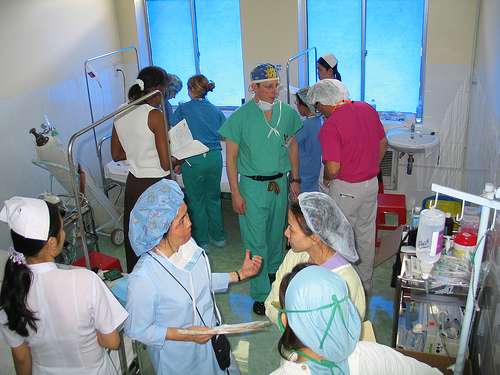 The number of Spaniards who work, directly or indirectly, in the Health Sector exceeds one million. Some authors even venture two million, counting more indirect employees. Surpassing the figure of one million is simple if we consider not only medical and pharmaceutical care, but related segments like elderly patients care, cosmetics, nutrition or animal health.
An increase in the next decades can be foreseen, given the continuous demand of health on the part of the population. The key of this increase in Spain is that, -unlike what happened in previous generations-, more and more citizens are willing to pay from their own pocket a complement for some treatments, on top of the contribution via taxes. Every day we see a growing tendency to use dentists, paediatricians, ophthalmologists, gynaecologists, hearing aids, plastic surgeons, etc. All this growth is translated into an increase of the employment in the sector.
A differential characteristic of this personnel working in Health is the professional qualification, that is remarkable with respect to other sectors, arriving to have almost 600,000 registered professionals. Farmaindustria esteems that more of 40% of the personnel employed by the pharmaceutical industry has a specific qualification, and there, University degrees are more than a half.
Employment in this sector shares three vectors that condition their careers: 1) permanent innovation that forces to a continuing update of knowledge, 2) specific legislation and regulatory subjects – a formidable challenge for outsiders, and 3) the role of the prescriber, -not in all cases the doctor-.
In Spain the biggest employer in health is the public sector. However, that no longer consolidates numbers in which was denominated INSALUD, since from the beginning of the century our 17 autonomous communities (CCAA) have HR competences transferred and count on his own personnel (SAS, ICS, Osakidetza, Sermas,etc.) and to collect homogeneous data is now a titanic task. As a last consolidated reference, -at the end of year 2000-, INSALUD counted 29,310 physicians, 68,225 non-physicians and 38,195 non-sanitary, totalling 135,730 people. It seems likely that in these ten years the CCAA will be using more personnel, although the total figure is now imprecise.
The data of registered sanitary professionals by theINE in year 2007 offers another valuable reference with nearly 600,000 professional registered, although some could be professionally non-active.
|
Total |
|||
| Doctors |
208.098 |
||
| ATS and DUE (Nurses) |
243.000 |
||
| Pharmacists |
61.300 |
||
| Veterinarians |
27.594 |
||
| Physiotherapy |
28.720 |
||
| Odonto and Estom. |
24.515 |
||
| Podiatry |
4.909 |
||
| Total: |
598.136 |
Source: INE. Registered health professionals in 2.007
On another segment, the Pharmaceutical Industry employs more than 39,100 people according to Farmaindustria data of 2007. A tendency observed is the encouraging growth of R&D activities , employing 4,616 professionals almost a 12% of the total. In traditional Pharmaceuticals growth is coming from hospital specialties like Oncology, Transplant, orphan drugs, etc, with reductions now widespread in Primary Care, and therapeutic areas already well covered like Digestive, Ostheoarticular, Respiratory, etc.
 Following from my recent post Recruitment differences in Health and Science last week I was invited to talk in Barcelona at the Personal España fair and exhibition about the differences that specialist recruiters have compared to generalists.
Basically I can identify three characteristics: consultants must have previous experience in the field, they understand and speak the language of clients and candidates and they also keep updated on the latest developments in the various segments of the industry. In short, both parts perceive that the consultant is “one of them”. This is not unique to Life Sciences; it happens the same with Finance, IT, etc.
In parallel, I was preparing a .ppt (with the help of Javier de Inocencio) presentation for the Life Sciences practice of my network Penrhyn International and had to summarize the advantages of these characteristics: Penrhyn-life-sciences-practice-presentation
1) A specialist recruiter can enrich the briefing with the client and even offer some benchmarking from the very beginning of the search.
2) Knows what target-companies to approach and whose not: it is more efficient. Complementary to this, can identify “lateral candidates”, the non obvious, sometimes temporarily in Consultancy, Services, another country, another function, etc.
3) Gets spontaneous referencing that is extremely valuable along the project.
4) Can focus the personal interviews on real key issues, avoiding generalizations and clichés.
5) When the practice consultants have complementary backgrounds and are based in different locations, they can also offer a true “global view” of the sector.
 What makes Biosciences executives different from other economy segments? It is commonly argued that it is a different industry with a certain endogamy seen in their companies and some functions. Apart from the unpredictability associated with basic research, a basic difference is that Biosciences project a global approach from the very moment that a molecule is identified. Here are three others:
* Permanent Innovation. With a clear science-and-research culture, innovation is embedding in this sector DNA. The most successful corporations are the ones with a clear commitment to R&D. An average R&D investment of 15%, that may go as high as 20% is difficult to beat for most industries, except sometimes IT or Telecom. Successful executives must get used to project management and drug development in many innovative disciplines such as Molecular Biology, Genetics, Nanotechnology, Proteomics, etc. Any professional headhunter knows that Biosciences CEO’s and VP’s must not be sought from mature or “comfortable” sectors .
* Regulatory Affairs. A challenge for executives coming from other sectors is market access. Price is not free in most countries, packaging cannot be changed without notifying the health authorities, distribution channels are well established with the role of Hospitals and Pharmacies also regulated. Moreover, promotional claims or DTC advertising must pass previous approval in almost every country, particularly for reimbursed products. Business Development deals require a quick adapting to new segments with a strong focus on health economics, outcomes and reimbursement.
* The role of prescription. When the ultimate customer, the patient, is often remote and not in direct contact with the innovator, a pharmaceutical o biomedical product requires the professional advice of a prescriber. This works in cascades: international opinion leaders(OL’s), national OL’s and local OL’s. Nowadays, specialists -in a clear shift from primary care- again prescribe the most innovative and attractive products. And the number of stakeholders has grown in recent times, including now clinical boards assessing new drugs, patients associations, medical societies and -in countries like Spain- autonomous communities authorities, etc.
The advent of personalized medicine will mean more specialist drugs for smaller groups of patients and a shift back to science vs. marketing, -that was so effective in the me-too and blockbuster era-. Executives used to work with that type of products need to reset to the new targeted-only business model and the recruiters involved in these types of searches must have the “helicopter view” necessary to differentiate segments and cultures, on top of speaking the language of the industry.
 Healthy Resources